Thursday, October 17, 2019

She has her mother's laugh - Carl Zimmer


A great read on the history of our understanding of Genes and factors affecting heredity.

Carl Zimmer packs the book with numerous anecdotes to keep you hooked.
Even for me, who quit on biology in school, the first 300 odd pages were a breeze. The next 300 was slightly more difficult, as the terms used were not familiar to me. 
But a delightful read throughout anyway

Do human races differ much genetically? Is there much in common, genetically speaking between an Asian, African and a European?
The author makes it very clear that though physical differences may appear amongst races on a superficial level to be very dramatic, they are determined by only a minute portion of the genome: we as a species have been estimated to share 99.9% of our DNA with each other. The few differences that do exist reflect differences in environments and external factors, not core biology.

And for that hotly debated issue- Is intelligence all genes? Well- partly says the author. It's genes and the environment that shape who we are.
And even though height is even more easily measurable than intelligence, scientists have still not been able to identify the genes that is responsible for it.
But height has also much to do with better food and health care systems. For instance South Koreans are more than an inch taller in comparison to North Koreans, which is a clear demonstration of how environment factors matter.  

Heredity is not just genes by the way. We inherit culture too! And most of us have traces of  Neanderthal genes in us.

One of the more heart warming stories in the book is on the treatment of  PKU or Phenylketonuria, a genetically determined metabolic disorder. Babies with PKU, if left untreated will have devastating brain damage.  

PKU is an inherited disease in which the body cannot metabolize an amino acid called phenylalanine. Normally phenylalanine is metabolized and converted into tyrosine, another amino acid, but if it stays as phenylalanine, there will be too much of it, and high levels of phenylalanine are harmful to the brain.

PKU was diagnosed as early as 1934. But scientists/doctors could not find a cure for it.
It all changed on account of one persistent mother, Mary Jones.

The journey to a treatment started in 1949, when a British woman named Mary Jones brought her seventeen-month-old daughter, Sheila, to a Birmingham hospital. Sheila couldn't stand or even sit up. Nor did she take an interest in her surroundings.
A doctor at the hospital named Horst Bickel examined Sheila and informed Jones that she had PKU. "Her mother was not at all impressed when I showed her proudly my beautiful раper chromatogram with the very strong phenylalanine (Phe) spot in the urine of her daughter proving the diagnosis," Bickel later recalled.
Jones wanted to know what Bickel was going to do now that he had discovered Sheila's disease. There was nothing to do,Bickel explained.
Jones rejected his answer. She came back the next morning to demand help. When he turned her down,she came back every morning.
She was very upset and did not accept the fact that at the time no treatment was known for PKU," Bickel said. "Couldn't I find one?".........
Jones was so insistent, though, that Bickel decided to talk to some of his colleagues about a diet for PKU. He learned that a biochemist in London named Louis Wolff had tried concocting a broth that could provide protein to people with PKU without poisoning them with phenylalanine. When he proposed feeding his broth to patients, his superiors at Great Ormond Street Hospital told him his job did not involve crazy treatments for the incurable.
Wolff gave his recipe to Bickel, who followed the directions, working in a frigid lab kept cold to prevent the concoction from spoiling.
Eventually, Bickel prepared enough of the stuff for Sheila. He instructed Jones that the girl was to eat nothing else. To his delight, the phenylalanine in Sheila's bloodstream dropped......
The diet even showed signs of improving her brain. Within a few months she began to sit up, then to stand, then to walk with assistance. Her musty odor even disappeared.
But when Bickel told his colleagues at the hospital, they scoffed. They were sure Sheila had improved merely thanks to the extra attention she was getting.
Bickel decided there was only one way to persuade them: take Sheila off of the diet.
Without telling Jones, Bickel secretly added phenylalanine to the formula. Within a day on the altered diet, Sheila started deteriorating. Soon she stopped smiling, making eye contact, or even walking. Bickel and his coworkers told  Jones of their secret maneuver, and put her back on the low-phenylalanine formula. While the transformation was enough proof for Bickel, he didn't think it would be enough to persuade skeptical colleagues. He got Jones's permission to bring Sheila into the hospital and feed her Phenylalanine again.
This time, Bickel .... captured his diet treatment to Sheila Jones in a movie. The movie is available on YouTube and a great watch.
https://www.youtube.com/watch?v=OqZ7QHO5_hs
Bickel's movie was impressive enough to change the minds of doctors at Great Ormond Street.

The treatment for PKU started. By the 1970s, the first generation of people treated for PKU since birth reached adulthood. They could finish school, hold jobs, have ordinary lives.
 In 2001,a graduate student named Tracy Beck became the first person with PKU to gain a PhD. She became an astronomer, helping to build the James Webb Space Telescope. For thousands of years, people who inherited the mutations in Beck's PAH genes would have looked to the sky and not known the word for the lights they saw. Now Beck was helping to extend humanity's gaze to the farthest edges of the universe.
 Sadly for Mary Jones, life wasn't fair on her. Suffering from mental illness herself, Mary Jones, a single mother, ended up in an institution. Sheila Jones learned to feed and dress herself, but could never learn to speak.

Sheila Jones has however been immortalised by the institution of an award in her name- The Sheila Jones Award in 2017. It is an award for patient advocates. This can be awarded to individuals, groups or organizations.

Epigenetics

A current fascinating field of study is epigenetics.   Epigenetics suggests that it possible for your experience to produce changes in your genes that could then be inherited by your children.  It opens up the possibility of a heredity of experience. 
It is being suggested that certain experiences — child neglect, drug abuse or other severe stresses — could set off epigenetic changes to the DNA inside the neurons of a person’s brain.
Jews, whose great-grandparents were chased from their Russian shtetls; Chinese whose grandparents lived through the ravages of the Cultural Revolution; adults of every ethnicity who grew up with alcoholic or abusive parents — all carry with them more than just memories. 
Our experiences, and those of our forebears, are never gone, even if they have been forgotten. The DNA remains the same, but psychological and behavioral tendencies are inherited. You might have inherited not just your grandmother’s knobby knees, but also her predisposition toward depression caused by the neglect she suffered as a newborn. Or for that matter if your grandmother was adopted by nurturing parents, you might be enjoying the boost she received thanks to their love and support.
Epigenetics, can be seen in plants: where what they experience affects future generations, many generations down. There's pretty good evidence in some animals like worms. But when we get closer to ourselves in mammals like rats, it gets more debatable. When we get to humans, a lot of researchers argue that they're isn’t really compelling data yet for it. 
Still a topic of debate and who know what the future holds?

CRISPR

However one of the biggest science stories of recent times is CRISPR (stands for Clustered Regularly Interspaced Short Palindromic Repeats)

CRISPR is basically a group of molecules that can edit DNA. You can fine tune the CRISPR molecules to go after any piece of DNA you want. They can cut that DNA and then you can actually insert a different piece of DNA in its place. 

So this could allow you for example to fix a defective gene. If somebody has cystic fibrosis for example, in theory you could use CRISPR to repair the gene that's faulty in them and then they would not suffer from cystic fibrosis any longer. And also against things like cancer because you can actually take people's own immune cells and edit their genes so that they can recognize and attack cancer cells.
Some scientists have repaired defective DNA in mice, for example, curing them of genetic disorders. Plant scientists have used CRISPR to edit genes in crops, raising hopes that they can engineer a better food supply. Some researchers are trying to rewrite the genomes of elephants, with the ultimate goal of re-creating a woolly mammoth. 
The days when CRISPR technology will be used to alter the genes of human embryos does not seem far off.
 There is at present a  self-imposed moratorium in the United States and Europe to work on human embryos. Not  in China though.  Reports suggest that researchers in China have actually proceeded to human clinical trials using CRISPR.

With CRISPR, it is easy to imagine a world where the haves and have-nots diverge even further in health outcomes than they already do — at the genetic level, because rich people can afford to enhance their genes and their yet-unborn kids’ genes for intelligence, musical ability, height etc.
So assuming we can figure out how to genetically engineer smarter, stronger sons and daughters, who is going to stop us?

 The book covers much more fascinating aspects on genes and heredity, and is definitely a recommended read. 

Monday, May 27, 2019

Land of Seven Rivers- Sanjeev Sanyal

I had picked up the Land of Seven Rivers by Sanjeev Sanyal  wanting a history re-brush of the Indian sub continent.

However the book focuses primarily on the Geography of Indian sub continent with a smattering of history thrown around.
And it fascinated me pretty much.

It is of course no surprise that there is much more to India than what we would like to believe.

The book covers the Indian Subcontinent right from the Pre-cambrian period, giving a bird's eye view on the formation of various geological features such as the Aravalli ranges, the Himalayas, the Gangetic plains etc and how civilizations thrived and folded through the ages upto the modern era.

There are numerous sites of significant Geographical and historical import scattered all around the country. Many a time one would have seen it or traveled across the same without being aware of its significance. I certainly have.

I will attempt to list a few of them here, with quotes liberally taken from the book, embellished with additional facts and pictures from the Internet.

Aravalli Ranges-'The oldest surviving geological feature anywhere in the world'

Map showing various ranges including Aravalli Ranges

Let us start with the Pre-Cambrian period.
More than a billion years ago,Earth had just one super continent called Rodinia. 
This super continent broke up around 750 million years ago and the various continents began to drift apart. This period is known as the Pre-Cambrian period.

The author says that there is one remaining relic from the Pre-Cambrian period that is still very visible-the Aravalli range. It is arguably the oldest surviving geological feature anywhere in the world.

The Aravalli Range extends approximately 692 km in a southwest direction, starting from Delhi and passing through southern Haryana, through to Western India across the states of Rajasthan and ending in Gujarat.

The northernmost point of the Aravallis is the North Ridge near Delhi University.


The North Ridge was the stage for an important turning point in Indian history. It was here that a small British garrison held out in 1857 against a much larger force of Indian rebels. 

A towering Mutiny Memorial was erected in 1863, in memory of the officers and soldiers of the  Delhi Field Force who laid down their lives during the siege of 1857. 
Erected in 1863 AD, in memory of the officers & soldiers of the Delhi Field Force who laid down their lives during the siege of 1857 #mutinymemorial #delhi #mutiny #1857 #gothic #memorial #redsandstone #architecture #india #incredibleindia #taylorsbattery
The Mutiny Memorial

The seven sides of the Mutiny Tower contains marble plaques honouring the soldiers of Delhi Field Force who died during the Mutiny of 1857.


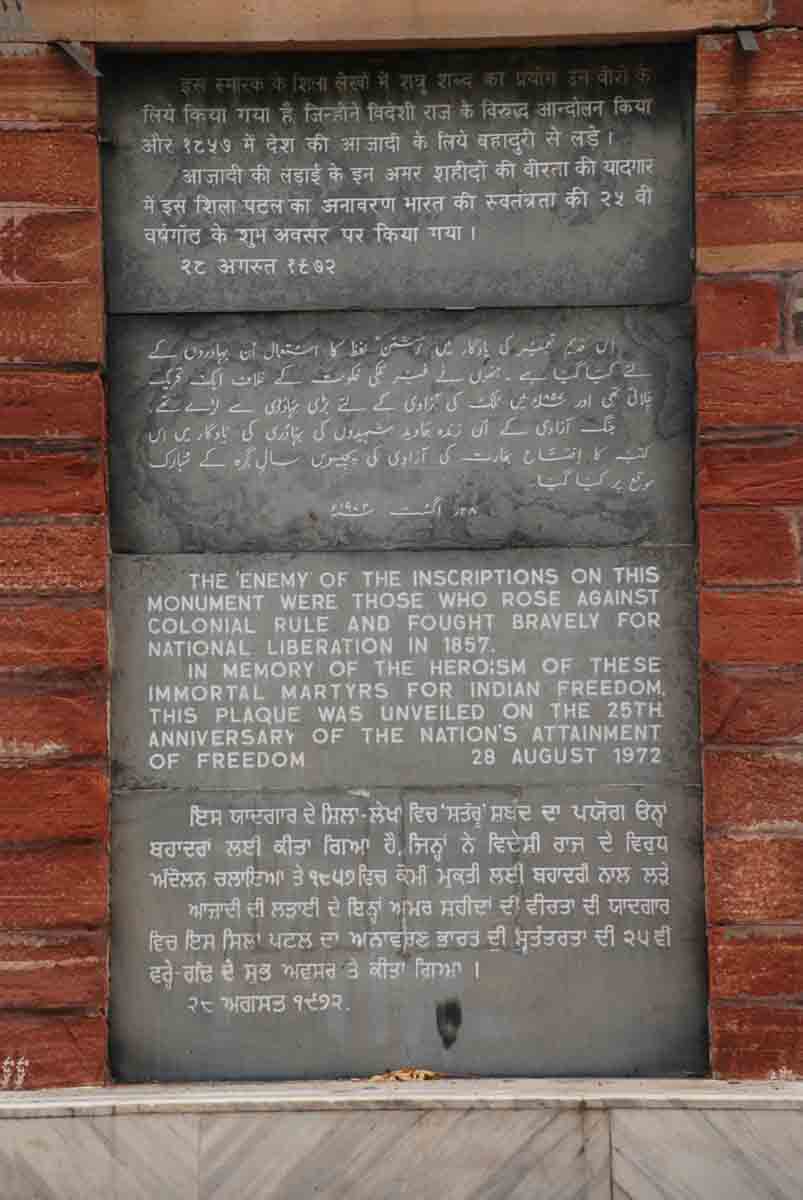
On 28 August 1972 the Mutiny Memorial was renamed Ajitgarh  and a plaque was put at its pedestal. Written in three languages Hindi, Urdu, English, It says that the “enemies” mentioned in the inscription were actually the freedom fighters and martyrs of India, who fought bravely against the repressive colonial rule in the First War of Indian Independence.

                           Ajitgarh Plaque

Farther south, near the Gujarat–Rajasthan border, the Aravallis briefly lay claim to being mountains rather than mere hills. The Guru Shikhar peak at Mount Abu rises to 1722 metres above sea level. 


Guru Shikhar peak

Dinosaur Park of India
A large number of dinosaur remains have been found in Raioli village of Balasinor taluka, Gujarat. The site was identified in 1981 and appears to have been a popular hatchery as thousands of fossilized dinosaur eggs have been found there. Fossilized bones have also been found including those of a previously unknown predator that was 25–30 feet long and two-thirds the size of the Tyrannosaurus Rex. The animal has since been named Rajasaurus Narmadsensis (means Lizard King of the Narmada).

Rajasaurus Narmadsensis
The Indroda Dinosaur and fossil Park in Ahmedabad, is a park which houses the fossilized remains and the petrified eggs of the dinosaurs.   
The Indroda Dinosaur and fossil park

Rock Caves of Bhimbetka
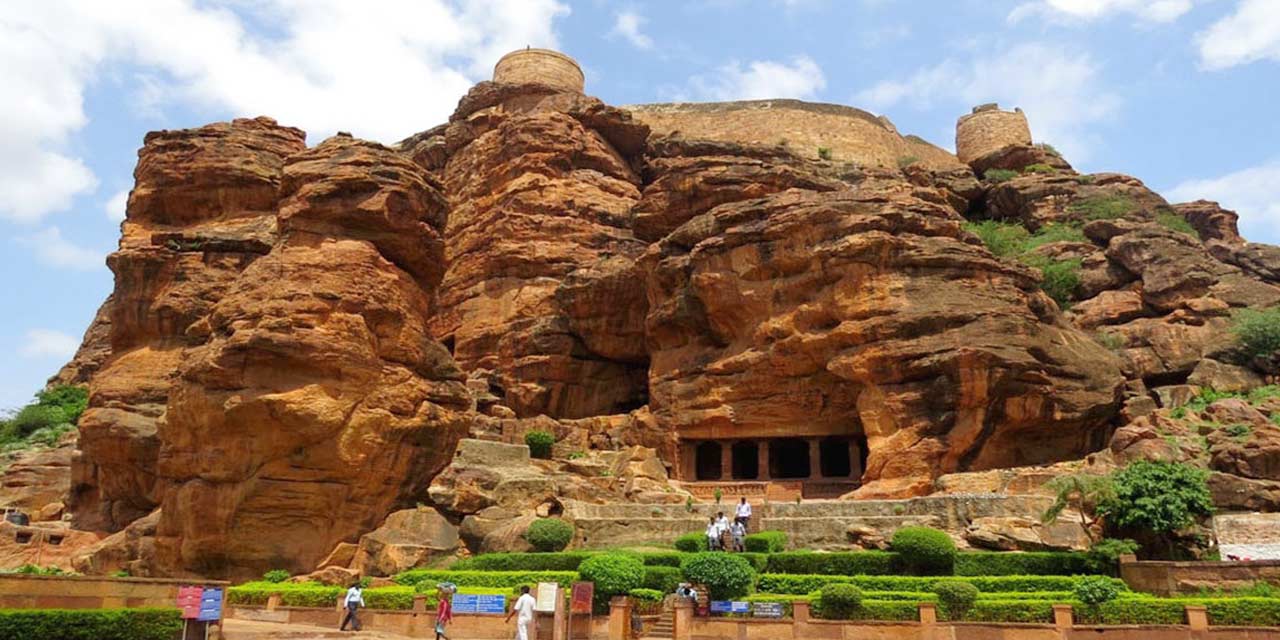
The Bhimbetka Rock Caves located in the Raisen District of Madhya Pradesh, about 45 kilometres Southeast of Bhopal, spans the prehistoric Paleolithic and Mesolithic periods, and exhibits the earliest traces of human life in the Indian subcontinent. It is a UNESCO world heritage site that consists of seven hills and over 750 rock shelters distributed over 10 kilometres. Discovered in the 1950s, the caves and rock shelters appear to have been inhabited almost continuously for over 30,000 years. Bhimbetka has rock paintings of animals and hunters from the Stone Age as well as of warriors on horseback from a later time (perhaps the Bronze Age). The paintings provide intriguing glimpses of the ancient origins of Indian civilization.


Bhimbetka Rock Caves
Dholavira- the largest Harappan Site
Dholavira is one of the five largest Harappan sites and the most prominent archaeological site in India belonging to the Indus Valley Civilization. Discovered in 1967-68, It is also considered as having been the grandest of cities of its time. Located in the Rann of Kutchh, the site was occupied from 2900 BCE, declining slowly after about 2100 BCE. 

Dholavira is a good example of a large Harappan urban centre. At the centre of the settlement is a ‘citadel’ which contained the homes of the elite as well as public buildings. In front of the citadel there is a large ceremonial ground beyond which was the planned area where the common citizens lived. 


Dholavira
Uttara path and Dakshina path
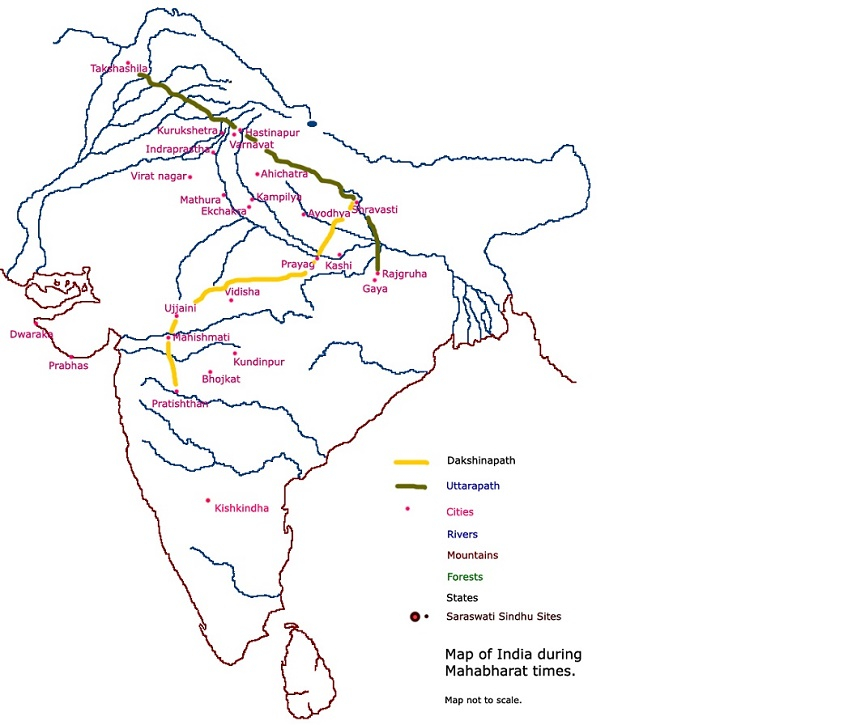
These ancient Highways, Uttara Path and Dakshina Path, played a very important role in shaping the political history of India. The geography of the great epics is intimately connected to these two great ancient trade routes. The locations mentioned in the Ramayana is oriented along the North–South axis while the Mahabharata is generally oriented on an East–West axis.

The Dakshina Path (or Southern Road) made its way from the Gangetic plains though Central India to the southern tip of the peninsula while the Uttara Path (or Northern Road) ran from eastern Afghanistan, through Punjab and the Gangetic plains, to the seaports of Bengal.
The Uttara Path was a well-trodden route by the Iron Age and formalized during the Mauryan Empire. Since then, it has been almost continuously rebuilt in some approximation to the original.  Sher Shah Suri, the Mughals, and the British invested heavily in maintaining it. The British called it the Grand Trunk Road and it survives today as National Highway 1 between Delhi and Amritsar and National Highway 2 between Delhi and Kolkata, and is part of the Golden Quadrilateral network.
In contrast, the path of the Dakshina Path has drifted over time although certain nodes remained important over long periods. During the early Iron age, the Dakshina Path probably began near Allahabad, then went in a South -Westerly direction through Chitrakoot and Panchavati(near Nashik) and eventually to Kishkinda( Near Hampi). This would probably be the route followed by Rama during his exile. 

Kishkinda
When Sita was abducted by Ravana, the powerful king of Lanka, Rama and his brother set out to find her. On the way, at a place called Kishkindha, they befriended a tribe of monkeys that promised to help them. Kishkindha, the kingdom of the monkeys is located near the medieval ruins of Vijayanagar at Hampi. The terrain consists of strange rock-outcrops, caves with Neolithic paintings, and bands of monkeys scampering over the boulders. It is such an evocative landscape that it is likely that Valmiki either visited it or had heard detailed descriptions of it from merchants plying the Dakshina Path or Southern Road. Not far away from this site is a sloth bear reserve that recalls Jambavan, Hanuman’s sloth bear friend.
Anjaneya parvat, the birthplace of Hanuman
Ram Sethu
On his march to Lanka, Rama finds that the sea bars the way. With the help of monkeys, a bridge is built (more accurately a causeway) from Rameswaram to Lanka. Even today, there exists a 30-km-long chain of shoals and sand-banks that links India to the northern tip of Sri Lanka. Whether one believes that these are the remains of Rama’s bridge or the result of a geological process, it cannot be denied that this is a remarkable feature. 
Ram Sethu
Locations mentioned in Mahabharata
Many of the places mentioned in the Mahabharata are located around Delhi. For instance, Gurgaon, renamed recently as Gurugram, was a village that belonged to Dronacharya, the teacher who trained the cousins in martial arts. The name Gurugram literally means the ‘Village of the Teacher’.

The Pandav capital of Indraprastha is said to be located under the Purana Qila in Delhi. Similarly, the site of Hastinapur is identified with a site near modern Meerut. The battlefield of Kurukshetra is nearby, in the state of Haryana.

Ashoka Edicts
The Edicts of Ashoka are a collection of more than thirty inscriptions on pillars as well as boulders and cave walls, made by Emperor Ashoka of the Mauryan Empire during his reign, from 268 BCE to 232 BCE. These pillars and inscriptions have been found across the subcontinent from Afghanistan in the north to Karnataka in the south, Gujarat in the west to Bengal in the east. 


The edicts describe in detail Ashoka's view about Dharma, an earnest attempt to solve some of the problems that a complex society faced and proclaim his  adherence to the Buddhist philosophy.
Even though these edicts were discovered  and were in the process of being deciphered from the beginning of the 19th century, it was only in 1915 that the identification of the Emperor named as Piyadassi in the edicts was linked to Asoka by C. Beadon, a British gold-mining engineer, at Maski, a village in Raichur District of karnataka.
Besides a few inscriptions in Greek and Aramaic (which were only discovered in the 20th century), the Edicts were mostly written in the Brahmi script and sometimes in the Kharoshti script in the northwest, the two Indian scripts used at that point in time.
Edicts of Asoka
Chunar Fort
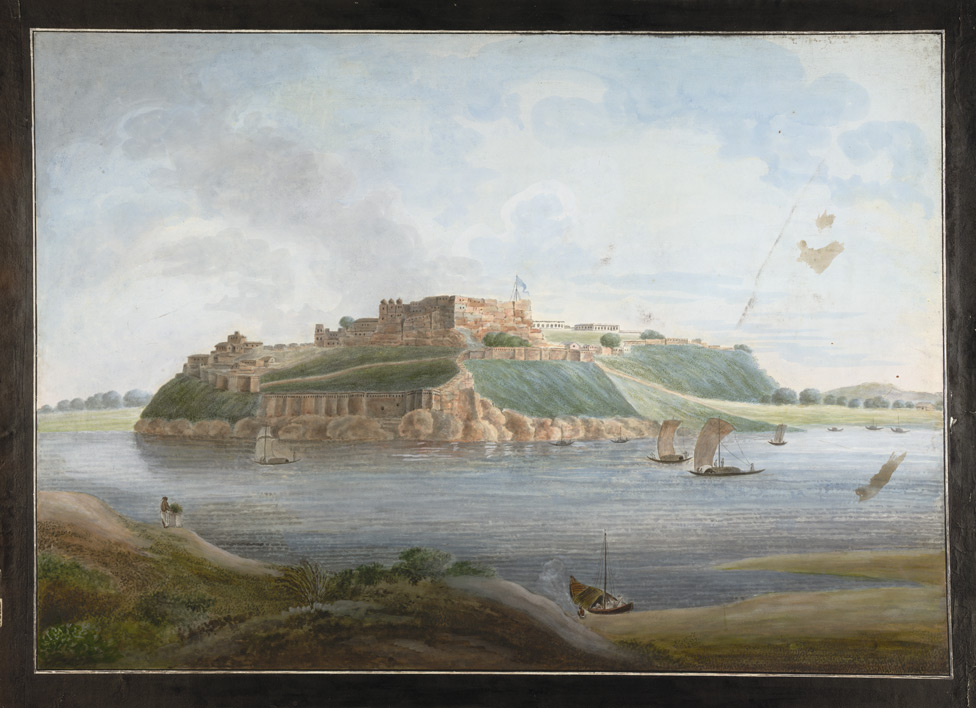
The youngest of India’s geological features—the Gangetic plains started out as a marshy depression running between the Himalayas and the mountain range of the Vindhyas.  The Ganga’s southward drift was arrested only when it nudged into the Vindhyas near Chunar (close to Varanasi). It is the only place in the plains where a hill commands such a view over the river, making Chunar fort a coveted strategic location. It was once said that he who controlled Chunar fort also controlled the destiny of India. A walk through the fort is a walk through Indian history. The walls resonate with tales of the legendary King Vikramaditya, the Mughals, Sher Shah Suri and Governor-General Warren Hastings.
Chunar Fort
Fort of Prithviraj  Chauhan 
Qila Rai Pithora, also known as Rai Pithora's Fort, was a fortified city built in the 12th century by Prithviraj Chauhan. Remains of the fort walls are scattered across South Delhi, visible in present Saket, Mehrauli around Qutb Complex, Kishangarh and Vasant Kunj areas 
Qila Rai Pithora
Hampi
In 1336 CE, the Vijayanagara Empire arose and grew into one of the famed Hindu empires of South India that ruled for over 200 years. The Vijayanagara Empire built its capital around Hampi, calling it Vijayanagara. By 1500 CE Hampi-Vijayanagara was the world's second-largest medieval-era city after Beijing, and probably India's richest.  
In 1565, at the Battle of Talikota, a coalition of muslim Sultanates entered into a war with the Vijayanagara Empire. They captured and beheaded the king, followed by a massive destruction of the infrastructure fabric of Hampi and the metropolitan Vijayanagara. The city was pillaged, looted and burnt for six months after the war, then abandoned as ruins.
 
Hampi
Forts of Diu
Portuguese control over the Indian Ocean was based on a network of forts along the coast. The best preserved of these forts is in Diu, a small island just off the Gujarat coast. The fort ramparts offers beautiful views of the Arabian Sea and has an impressive array of sixteenth- and seventeenth-century cannons.
The fort was built in 1535 subsequent to a defense alliance forged by Bahadur Shah, the Sultan of Gujrat and the Portuguese when Humayun, the Mughal Emperor waged war to annex this territory. The fort was strengthened over the years, till 1546. Portuguese ruled over this territory from 1537 (from the year they took control of the fort and also the Diu town fully) till 1961 (for 424 years, the longest period by any colonial rule in the world)till they were forced to quit  in December 1961.
Diu Fort
Gurdwara Sis Ganj Sahib
Gurdwara Sis Ganj Sahib is one of the nine historical Gurudwaras in Delhi. It was first constructed in 1783 by Baghel Singh Dhaliwal to commemorate the martyrdom site of the ninth Sikh Guru, Guru Tegh Bahadur. Situated in Chandni Chowk in Old Delhi, it marks the site where the ninth Sikh Guru was beheaded on the orders of the Mughal emperor Aurangzeb on 11 November 1675 for refusing to convert to Islam and protesting against the forceful conversion of Kashmiri Pandits and dharmic people. However, before their body could be quartered and exposed to public view, it was stolen under the cover of darkness by one of his disciples, Lakhi Shah Vanjara who, then burnt his house to cremate Guru's body; today, at this site stands Gurudwara Rakab Ganj Sahib.
Gurdwara Sis Ganj Sahib
Minto Park
Minto Park, officially Madan Mohan Malaviya Park, is a park in Allahabad, located in the southern part of the city along the banks of Yamuna River. It is a historical site wherein in 1858, Lord canning read out the declaration of Queen Victoria's Proclamation which resulted in the complete transfer of control over India from The East India Company to the Government of Britain. The park is named after Earl of Minto, who in 1910, laid a Column with a four-lion symbol on the park to commemorate the event.
The column commemorating the Queen’s Proclamation, after independence, has been capped with a replica of the national emblem, the Mauryan lions and the wheel. 


 Minto Park

The focus of the book has generally been North Centric, probably because that is what captures the popular imagination. There would be similar such gems littered all over the North East India and other remote parts of South India for certain. 

Monday, April 1, 2019

American Gods- Neil Gaiman

I think it's from page 350 that the book starts going somewhere. Or was it 400?


Shouldn't be a recommended read. But then Gaiman spins a good yarn and the languid pace of the book doesn't bug you as much.

You adjust to the pace of the book. Almost. You start enjoying the long(aimless?)walks by the protagonist, Shadow and you enjoy the strange tales of the Gods, which keep cropping up time and again.

And the book is littered with gems such as:

"Still, there was a tale he had read once, long ago, as a small boy: the story of a traveler who had slipped down a cliff, with man-eating tigers above him and a lethal fall below him, who managed to stop his fall halfway down the side of the cliff, holding on for dear life.

There was a clump of strawberries beside him, and certain death above him and below.

What should he do? went the question. 

And the reply was, Eat the strawberries. 

The story had never made any sense to him as a boy.

It did now. So he closed his eyes, threw himself into the kiss and experienced nothing but Sam’s lips and the softness of her skin against his, sweet as a wild strawberry."

Made sense to me. 'Eat the strawberries'. My personal (dys)functional philosophy.

And:

"A voice from behind him, in the shadows, said, very quietly, ‘You have never disappointed me.’ 
Shadow did not turn. ‘That’s weird,’ he said. ‘I disappointed myself all the way. Every time.’"

All said and done the storyline itself is nothing much. And that can be counted as a negative. Hence the three stars.

Thursday, June 7, 2018

The fabric of the Cosmos - Brian Greene(2004)

I would be out of my depth if I even attempted a book review here.

So no. Not doing that. 

It’s a fantastic read, goes without saying.

Will share a few weird facts of the Cosmos as brought out in the book, though.

The Universe is, to say the least, not what you think it is. It is a weird place.

So we humans should feel right at home being here.

#1 Weird Fact:  Space and Time are not Immutable and Unchangeable

Let’s start with the big things first. What is Space and Time? Isn’t it immutable and unchangeable? Isn’t Space and Time the grand arena, the unchanging permanent components of the Universe where stuff happens like galaxies colliding, supernovas, Earth going around the Sun, night becoming day etc?

Isaac Newton thought so too.

In his Principia Mathematica, Newton articulated a conception of Space and Time, declaring them absolute and immutable entities that provided the universe with a rigid, unchangeable arena.

As far as Time was concerned, Newton even made the sweeping statement that he couldn’t be bothered trying to explain what Time is all about, as everyone knows what Time is.

That is deep.

But for Albert Einstein, Space and Time were not absolute and immutable.

His insight into the very special nature of ‘light’ got him thinking on the nature of Space and Time.

As a teenager, Einstein asked: What happens if you move at light speed?

What would a light wave look like if you were to chase after it at exactly light speed? Since you and the light wave would be zipping at exactly the same speed, you would be keeping perfect pace with the light. And so, the teenage Einstein concluded, from your perspective the light should appear as though it wasn’t moving. You should be able to reach out and grab a handful of motionless light just as you can scoop up a handful of newly fallen snow.

This fantastic theory sort of makes sense.

But Einstein himself, in 1905, in his Theory of Special Relativity, postulated that the speed of light is a constant, no matter what the relative motion of the observer.

So regardless of your state of motion, whether you chase a light beam, or run from it, or just stand still, the light retains its one fixed and never changing speed of about 3,00,000 Km per second.

So Light will never appear stationary. No matter how fast you move.

From this radical postulate that the speed of light is a constant, Einstein concluded that Space and Time are relative, not absolute and immutable as Newton assumed it to be.

Each of us carries our own clock, our own monitor of the passage of time.

Each clock is equally precise, yet when we move relative to one another, these clocks do not agree. They fall out of synchronization; they measure different amounts of elapsed time between two chosen events.

This postulate of Einstein - that we all carry our ‘own clocks’, was proven by the famous Cesium Clock Experiment.

In 1971, Joseph Hafele and Richard Keating flew state-of-the-art Cesium-beam atomic clocks around the world on a commercial Pan Am jet. When they compared the clocks flown on the plane with identical clocks left stationary on the ground, they found that less time had elapsed on the moving clocks. The difference was tiny—a few hundred billionths of a second—but it was precisely in accord with Einstein’s discoveries.

So what it means is that when you move, Time travels more slowly for you than for someone who is stationary.

The same is true of distance or Space. Each of us carries our own yardstick, our own monitor of distance in space. Each yardstick is equally precise, yet when we move relative to one another, these yardsticks do not agree; they measure different distances between the locations of two specified events.

If Space and Time did not behave this way, the speed of light would not be a constant. Space and Time adjust themselves in an exactly compensating manner so that observations of light’s speed yield same result, regardless of the observer’s velocity.

#2 Weird Fact: You are Moving at Light Speed

Einstein said that when you are stationary, you move at Light speed.

At 3,00,000 Km per second. But through Time.

In his theory of Special Relativity Einstein postulated the concept of ‘Movement through Time’.

Consider this:

We are used to the fact that objects can move through space.

But Einstein said that there is another kind of motion that is equally important: objects also move through Time.

Right now, the watch on your wrist and the clock on the wall are ticking away, showing that you and everything around you are relentlessly moving through time, relentlessly moving from one second to the next.

Newton thought that motion through time was totally separate from motion through space-he thought these two kinds of motion had nothing to do with each other.

But Einstein found that they are intimately linked.

In fact, the revolutionary discovery of Special Relativity is this: When you look at something like a parked car, which from your viewpoint is stationary—not moving through space, that is—all of its motion is through time. The car, its driver, the street, you, your clothes are all moving through time in perfect sync: second followed by second, ticking away uniformly. But if the car speeds away, some of its motion through time is diverted into motion through space.

The speed of the car through Time slows down, when it diverts some of its motion through time into motion through Space.

This means that the car’s progress through time slows down.

And therefore time elapses more slowly for the moving car and its driver than it elapses for you and everything else that remains stationary.

Special Relativity declares that the combined speed of any object’s motion through Space and its motion through Time is always precisely equal to the speed of light.

The maximum speed through Space is reached when all light-speed motion through time is fully diverted into light-speed motion through space—one way of understanding why it is impossible to go through space at greater than light speed.

Light, which always travels at light speed through space, is special in that it always achieves such total diversion.

Time stops when travelling at the speed of light through space. A watch worn by a particle of light would not tick at all. Light realizes the dreams of Ponce de León and the cosmetics industry: it doesn’t age.

#3 Weird Fact: Space is Warped and Curved

Why does the Earth go around the Sun? Or the moon around the Earth?

It’s because Space is curved and warped.

Not smooth and featureless as one might expect.

If you roll a marble on a smooth wooden floor, it will travel in a straight line. But if you recently had a terrible flood and the floor dried with all sorts of bumps and warps, a rolling marble will no longer travel along the same path. It will be guided this way and that by the warps and curves on the floor’s surface.

In 1915, in his Theory of General Relativity, Einstein postulated that the presence of matter or energy has an effect on Space much like the effect the flood had on the floor. Matter and energy, like the sun, cause Space to warp and curve.

And just as a marble rolling on the warped floor travels along a curved path, Einstein stated that anything moving through warped space—such as the earth moving in the vicinity of the sun—will travel along a curved trajectory.

That, according to Einstein, is how gravity exerts its influence amongst heavenly bodies and everything else in the Universe.

#4 Weird Fact: The Quantum World

If you thought the Cosmos is kinda weird, then you probably have not been introduced to the Quantum world as yet.

That’s where things get truly insane.

Einstein classified Quantum mechanics in precise scientific terms: Spooky

Consider a few bizarre facts predicted by quantum mechanics and scientifically proven:

# Non Locality

Quantum mechanics predicts that interconnections between two particles need not be local.

What this means is that something that happens here can be entwined with something that happens far away, even if nothing travels from here to that location far away. It’s called Entanglement.

Quantum connection between two particles persists even if they are on the opposite sides of the Universe.

For example, consider two people standing on opposite sides of a lake wearing sunglasses. Light from the surface of the lake reflects and photons are emitted. Quantum mechanics shows that there is a 50-50 chance that a particular photon reflected towards you from the surface of a lake will make it through your sun glasses.
When the photon hits the glass, it randomly “chooses” between reflecting back and passing through. The astounding thing is that such a photon can have a partner photon that has sped miles away in the opposite direction and yet, when confronted with the same 50-50 probability of passing through the sun glasses of the person standing on the opposite side of the lake, will somehow do whatever the initial photon does. Even though each outcome is determined randomly and even though the photons are far apart in space: if one photon passes through, so will the other.
This is the kind of nonlocality predicted by quantum mechanics.

Quantum Mechanics says that two things can be separated by an enormous amount of space and yet not have a fully independent existence. A quantum connection can unite them, making the properties of each contingent on the properties of the other.

# Probability wave of an electron

According to quantum mechanics, every probability wave of an electron extends throughout all of space, throughout the entire universe. In many circumstances, though, a particle’s probability wave quickly drops very close to zero outside some small region, indicating the overwhelming likelihood that the particle is in that region.

Nevertheless, so long as the probability wave of an electron somewhere in the Andromeda galaxy has a nonzero value, no matter how small, there is a tiny but genuine—nonzero—chance that the electron could be found there.

So what it means is that there is a probability that the single electron you just exhaled sitting in your room can be found on the dark side of the moon.

# Position and velocity of a particle

Quantum mechanics claims that the position and the velocity of a particle cannot simultaneously have definite values.

Instead, particles hover in quantum limbo, in a fuzzy, amorphous, probabilistic mixture of all possibilities; only when measured is one definite outcome selected from the many.

#5 Weird Fact: Time is Illusory

The passage of Time is illusory.

The past, present and future have already happened.

It’s like the movie reel. Each portion of the reel captures a particular scene. When you watch the movie, you have the illusion of various scenes playing out moment after moment. But that is just an illusion.

Similarly, events in the entire Universe- past, present and future have already occurred.

Or to put it differently, the past, present and future all exist simultaneously. What you experience as a flow of time is just an illusion. The Big Bang and the end of the Universe have all occurred and exist as frozen moments in time.

We intuitively ascribe this particular moment, this ‘Now’ to be same for everyone across the Universe.

For instance, if in this ‘Now’, am reading a book and someone is watching a movie in New York, and simultaneously a Volcano is erupting in Jupiter, we believe this ‘Now slice’ of Space-time should be the same for everybody.

But this view is dated.  A Newtonian way of envisioning reality.

According to Newton’s absolute space and absolute time, everyone’s freeze-frame picture of the Universe at a given moment, contains exactly the same events; everyone’s ‘Now’ is the same ‘Now’, and so everyone’s ‘Now-list’ for a given moment is identical. If someone or something is on your ‘Now-list’ for a given moment, then it is necessarily also on my ‘Now-list’ for that moment.

Most people’s intuition is still bound up with this way of thinking, but Special Relativity tells a very different story.

As already explained, Time moves slower for someone in motion as compared to someone stationary.

So there are ‘Different Now’s’ for the ones moving and those stationary. Their clocks will not match.

Observers moving relative to each other have different conceptions of what exists at a given moment, and hence they have different conceptions of reality. At everyday speeds, the angle between two observers ’Now-slices’ is minuscule; that’s why in day-to-day life we never notice a discrepancy between our definition of ‘Now’ and anybody else’s.

The author gives an example to drive this point home. A thought experiment:

Imagine that Chewie is on a planet in a galaxy far, far away—10 billion light-years from Earth—idly sitting in his living room.

Imagine further that you and Chewie are not moving relative to each other. Since you are at rest relative to each other, you and Chewie agree fully on issues of space and time: you would slice up space-time in an identical manner, and so your ‘Now-lists’ would coincide exactly.

After a little while, Chewie stands up and goes for a walk—a gentle, relaxing amble—in a direction that turns out to be directly away from you. This change in Chewie’s state of motion means that his conception of ‘Now’, his slicing up of space-time, will rotate slightly.

This tiny angular change has no noticeable effect in Chewie’s vicinity: the difference between his new ‘Now’ and that of anyone still sitting in his living room is minuscule.

But over the enormous distance of 10 billion light-years, this tiny shift in Chewie’s notion of ‘Now’ is amplified.

His ‘Now’ and your ‘Now’, which were one and the same while he was sitting still, jump apart because of his modest motion. If Chewie walks away from you at about 10 miles per hour, the events on earth that belong on his new ‘Now-list’ are events that happened about 150 years ago, according to you!

According to his conception of ‘Now’—a conception that is every bit as valid as yours and that up until a moment ago agreed fully with yours—you have not yet been born!

If he moved towards you at the same speed, the angular shift would be opposite, so that his ‘Now’ would coincide with what you would call 150 years in the future! Now, according to his ‘Now’, you are no longer be a part of this world.

And if, instead of just walking, Chewie hopped into the Millennium Falcon travelling at 1,000 miles per hour (less than the speed of a Concorde aircraft), his ‘Now’ would include events on Earth that from your perspective took place 15,000 years ago or 15,000 years in the future, depending on whether he flew away or towards you.

So: if you buy the notion that reality consists of the things in your freeze-frame mental image right now, and if you agree that your ‘Now’ is no more valid than the ‘Now’ of someone located far away in space who can move freely, then reality encompasses all of the events in space-time.

If we can visualize ‘all of Space’ as really being out there, as really existing, we could also visualize ‘all of time’ as really being out there, as really existing, too.

Past, present and future certainly appear to be distinct entities. But, as Einstein once said, “The distinction between past, present and future is only an illusion, however persistent.”

The only thing that’s real is the whole of space-time.

In this way of thinking, events, regardless of when they happen from any particular perspective, just are. They all exist. They eternally occupy their particular point in space-time.

There is no flow. If you were having a great time at the stroke of midnight on New Year’s Eve, 1999, you still are, since that is just one immutable location in space-time.

This book is a great read for the layman.

And the weirdness quotient of the Universe just increases when the author talks of Multi-verse, hidden dimensions, String Theory...

Can’t recommend this book enough.